Behaviourism
This week’s module on Behaviourism and Cognitivism provided us with more insight into these learning theories. The Behaviourist theory concentrates on the change in external behaviours with Pavlov demonstrating that a conditional stimulus led to a conditional response. Taking it a step further Skinner’s approach called operant conditioning stated that the behaviour of the subject determines the response to the subjects own actions. It was not until the 1960s that cognitive approaches recognised that there was a requirement for internal mental processing to take place for learning to occur. When reflecting on behaviourism my first impression was that it’s outdated, Pavlov’s theory goes back to 1927. The suggestion that all humans are blank slates who bring nothing to the learning process did nothing to enhance its reputation as a learning theory for me. Yet the effects of behaviourism can be seen in how we plan our training today. Gagner and Medsker’s instructional design principles are influential in how curriculums are planned. All module content and assessments are based on learning outcomes another impact of behaviourism. The diagram below from John Biggs illustrates how learning outcomes are central to content and assessment when designing training.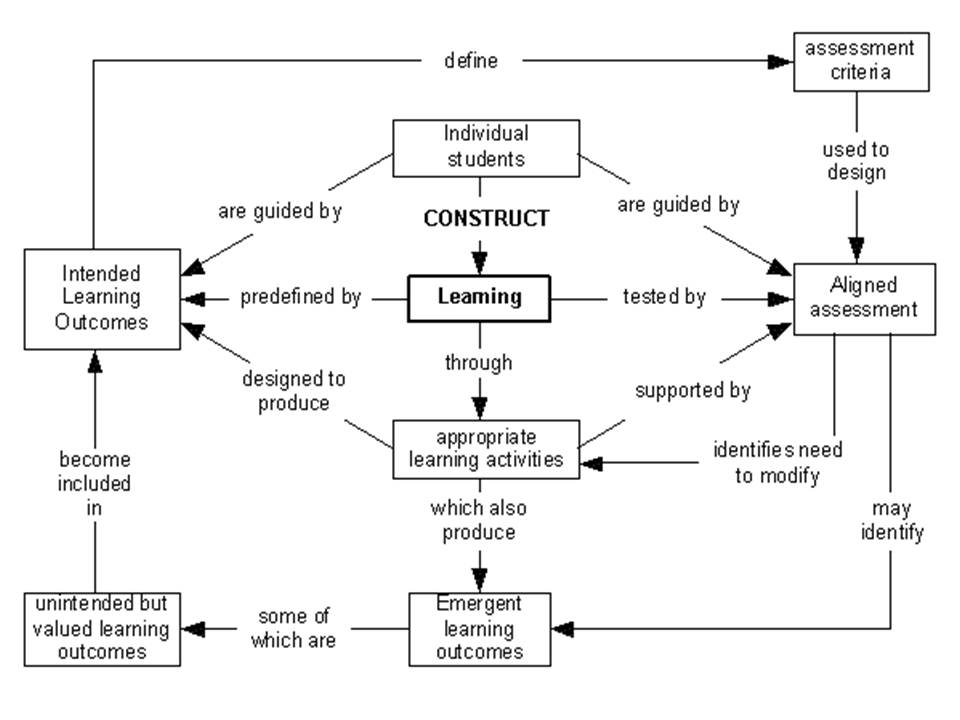
John Biggs (2003): Aligning Teaching and Assessment to Curriculum Objectives
Recently training took place for some of our managers. It was an online course that was developed to help managers deal with issues in one-to-one meetings. Managers had to reflect on each module and identify what aspects of the module they would apply at future meetings as suggested by Kolb in his model on experiential learning. The final aspect of the training was a skills demonstration. Managers were given a scenario and asked to prepare how they would deal with it. They were asked to demonstrate their skills through a role play which was videotaped. The results have been made known to the managers by the company providing the training. However on reflection I feel that a key aspect was missing from the results - feedback. The opportunity to receive feedback would have reinforced the positive behaviours displayed by managers during the role play. It is envisaged that courses similar to this one will take place again in the future. My suggestion to the suppliers will be that feedback should be provided to students so that can identify where they have been successful and look to improving areas that they need to work on. September 2011
