Context and Rationale
The ubiquitous availability of the internet has led to its use as an instructional medium and the growth of various types of online training. Distance learning, e-learning or blended learning are descriptions used frequently as corporate employees log on to instructional sites at work between meetings or at home (Taran, 2006). For organisations, online learning allows the delivery of learning to more employees at a lower cost with ability to track and report on their progress (Dublin, 2011). Currently the Chartered Institute of Personnel and Development (CIPD) in its Learning Talent and Development Survey (LT&DS) 2011 note that economic trends have negatively impacted on the resources available for learning and development within organisations though there is a “continued acceleration of e-learning” (CIPD, 2011, p. 35) as a major driver in organisational training. Despite reduced budgets there is a need now more than ever to produce learning content at a faster pace. Employees jobs are constantly changing, learning time is reduced and yet there is an expectation for employees to be ready to perform, faster than before so organisations may gain and sustain competitive advantage (Taran, 2006). Harward (as cited in Jennings, 2012, p 9) suggests that “speed will become the new mantra” of the learning and development professional while Dublin (2011) posits that the goal for learning and development departments is to continue to deliver training “faster, cheaper and more of it”.
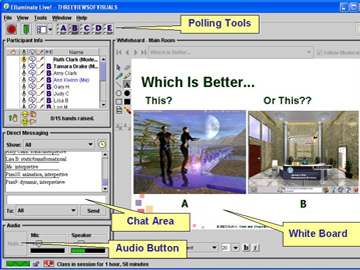
In order to improve efficiencies in programme delivery and meet the challenges of faster delivery, technology facilitating the delivery of tutorials in an online synchronous environment or virtual classroom (see figure 1) is being implemented in an Irish based insurance company. The technology will supplement rather than replace the existing training solutions which include classroom based training, one to one coaching and e-learning modules delivered via the Moodle platform. Whilst the immediate use of the virtual classroom will be to deliver tutorials to meet compliance requirements it is anticipated that in the long term the virtual classroom will become part of a blended approach to learning and provide benefits similar to that experienced by Seagate Technology. Their programme “Maximising Business Results” was delivered using live virtual sessions and included virtual team studies and off line self-study. The new format reduced course time from 160 hours to 48 hours of modularised sessions (Dublin, 2011).
Hrastinski (2008) suggests that for e-learning initiatives to succeed within organisations it is necessary to understand the affordances of different e-learning techniques and methods. The learning and development team in the insurance company have never delivered or attended a tutorial using virtual classroom technology, they are unaware of the affordances and limitations of the technology. The purpose of the research is to undertake a review of current literature to ascertain appropriate strategies for the design and delivery of content in an online virtual classroom, this position is supported by Grandzol & Grandzol (2006) who suggest that while individual training styles should not be stifled, a failure to learn from the results of legitimate research may inhibit the quality of the training delivered. In addition the research will look at the experiences of training instructors skilled in face to face delivery of content as they move to teaching in an on line synchronous environment and identify the challenges they experience and how they can be surmounted.
Research Aims and Objectives
The introduction of new technology within the insurance company provides a choice of synchronous and asynchronous technology to deliver training. (Hrastinski, 2008) suggests that organisations are interested in developing synchronous and asynchronous e-learning but have limited understanding of the benefits and limitations of each type. This research aims to identify appropriate strategies from existing literature regarding design and delivery of content in a web based synchronous environment. A secondary aim is to ascertain the experiences of trainers as they move to delivering content using a new medium. This leads to the research topic
“Delivering synchronous online tutorials using web based technology: Strategies and experiences of workplace trainers using a new medium.”
Arising from these aims the following research questions will guide the collection of data for this study:
Ø What pedagogical approaches should trainers consider when designing content for delivery in a synchronous online environment
Ø What difficulties are experienced by trainers delivering online tutorials compared with face to face training
Ø What practical supports are required for trainers new to teaching in a synchronous online environment
Ø What information does this study provide to assist other workplace trainers new to the design and delivery of content in a synchronous online environment?
Literature Review
Literature points to the characteristics of the virtual classroom as an environment that facilitates the use of a variety of communication resources such as, audio-video conferencing, text messaging, desk top sharing, joint web browsing and electronic white boards (Falloon, 2011a; Teng, Chen, & Leo, 2012). Stafford & Lindsey (2006) contend an increase in the social presence in a synchronous environment provides students with the sense and benefits of the traditional classroom or seminar, while Taran (2006) posits that the technology allows for the most important component in education which is the teacher.
Both Jung (2001) and Anderson (2008) suggest the ability of the technology to support content in multiple formats allows the creation of learning content which exploits the attributes of different media. The authors point to the flexibility of the environment to use content generated on the web by both instructor and student. However Kear, Chetwynd, Williams, & Donelan (2012) indicate tutors new to the environment can struggle to adapt pre-prepared material or create new material in a web conferencing environment and suggest prior planning is essential to ensure tutors have a choice of resources to draw on during live sessions in order to respond to students’ demands as they arise.
Yang & Liu (2007) suggest the potential inherent in the technology lies in its ability to facilitate an interactive environment for learners and opportunities for contextual discussion. Carr, Gannon-Leary, Allen, Beattie-Huggan, McMurray, & Smith, (2008, p. 572) suggest it provides “an intimate” method of communication while Salmon (2000, p.69) notes that synchronous conferencing offers learners “immediate contact, motivation and even fun”. Falloon’s (2011b) study with education students using a virtual classroom used Moore’s (1987) Transactional distance Theory as a framework for research. The study illustrated the positive impact of the virtual classroom on dialogue among students, between student and teachers and between student and content. Students were able to give and gain immediate feedback and seek immediate clarification from the tutor and fellow students. Taran (2006) suggests this interaction with other students and the lecturer allows students to argue their viewpoints and refine their opinions. The ability of the synchronous environment to facilitate discussion can be viewed both as a positive and a challenge to students. Hrastinski (2008) suggests that students motivation to engage in dialogue is increased in a synchronous environment as they feel an immediate response is more likely, McBrien & Jones (2009) highlighted shy students felt more comfortable becoming involved in discussions online and Falloon’s (2011b) findings indicated students preferred the non-permanent nature of the online environment, suggesting it allowed them to try out ideas with other students rather than post ideas to a discussion forum which they felt was a more permanent record. It is interesting to note in Falloon’s (2011a) study students commented they were unsure how to act in the new environment and didn’t feel comfortable asking questions. Barnhart & Stanfield (2011) suggest it takes practise and patience to get used to the new environment. In addition Falloon’s (2011a) students acknowledged the convenience of the virtual classroom for meeting online to deal with group work issues rather than using email or discussion fora but suggested that the synchronous nature of online discussion did not allow them reflect sufficiently to contribute. Falloon’s (2011a) findings support Hrastinski (2008) conclusions that synchronous discussion supports more social interaction while asynchronous discussion increases the ability to process information and promotes reflection.
The same environment poses other challenges for learners and tutors, Studies illustrate that too many simultaneous interactions (McBrien & Jones, 2009), inappropriate pace of discussion (Ng, 2007) and technical and infrastructure issues (Falloon, 2011a; Kear et al, 2012) impact on the learners experience in the virtual classroom. Falloon’s (2011b) study highlighted the lack of flexibility of the virtual classroom as students found the requirement to be present at regular tutorials was inconvenient and went against the reason they opted for online study. Kear et al (2012) suggests that dealing with the multiple tools available in the virtual classroom and parallel contributions from students led to cognitive load for tutors. These tutors were experienced in teaching online but struggled in a synchronous environment.
Whilst the virtual classroom has affordances and limitations there are external factors that can enhance or detract from the experience. Falloon (2011b) describes these factors as poor broadband connections, a lack of adequate computer equipment and the levels of student technical competence. While Carr et al (2008) suggest the aspect that facilitated discussion was the natural ability of the consultant in the study to build rapport with students rather than the technology itself.
Coming to the role of the online teacher Anderson (2008) and Brinthaupt, Fisher, Gardner, Raffo, & Woodard,(2011) agree that an excellent e-teacher is an excellent teacher. Brinthaupt et al (2011, p. 516) propose that literature tends to deal with the “science” rather than the “art” of teaching online. They look at the characteristics of good teachers as defined by Bain (2004) and ask given the differences between face to face and online teaching how can tutors “make a difference” (Brinthaupt et al 2011, p. 515) with online students. Using the categories of fostering student engagement, stimulating intellectual development and building rapport with students Brinthaupt et al (2011) discuss ways that these concepts can be achieved making the point that none of the methods suggested are contingent on the mode of delivery. Whilst Anderson (2008, p. 360) describes the characteristics of an excellent teacher as one likes dealing with learners, has pedagogical understanding of the learning process and can “orchestrate, motivate and assess” effective learning, he admits that the e-teacher requires a set of technical skills which allow for “comfort and competence” in the online environment. Salmon (2000 p. vii) coins the phrase “e-moderator” to describe the online tutor and describes the multiple roles that an e-moderator can expect to fill during a tutorial. These roles range from “Online Host” (Salmon, 2000, p.214) ensuring everyone is greeted to “Online Concierge” (Salmon, 2000, p.215) providing support and information and “Online Gardener” (Salmon, 2000, p.216) helping learners acquire and cultivate knowledge. Salmon (2000) makes the point that no one is born with the skills required for e-moderating and it has not been possible to learn them vicariously through observation while we ourselves were learning. Brinthaupt et al (2011) concur and suggest the perceived difficulty of teaching online can be attributed to a generation of teachers who have been taught in traditional classrooms.
Looking at pedagogical approaches for the Virtual Classroom London & Hall (2011) suggest interventions using web 2.0 technology such as a virtual classroom supports both adaptive learning and generative learning. They define organisational adaptive learning as communicating policies and procedures especially those related to compliance and generative learning as collaborative problem solving. This discussion supports Jung’s (2001) earlier suggestion that web based learning is not pedagogically innovative as the pedagogical features of web based instruction can be understood from behaviourist, cognitivist and constructivist perspectives. Yang & Liu 92007) illustrate the pedagogical capabilities of the virtual classroom by creating a virtual classroom composed of two parts, an instructional communicating environment (ICE) and a collaborative learning environment (CLE). Their research indicates that learners and teachers believed ICE can effectively support students to learn and CLE can effectively promote students to learn actively. The initial use of the technology in the insurance company will be to deliver low interaction lectures. This compares to the content delivered in Taran’s (2006) study which was complex and needed to be instructor led. It was decided to present the content in a social context that allowed students interact with the instructor. Holmberg (as cited in Anderson 2008, p. 347) describes this as “guided didactic interaction”. Content is presented in a conversational style and uses personal reflections, anecdotes and discussions of the teachers own success or struggles with the topic. This approach may prove useful to overcome the lack of interaction students may have in this context.
The research design will be underpinned by the action research spiral process advocated by Berg and Lune (2012) see figure 2. As the virtual classroom technology has not been used by any participant with the exception of the researcher the first cycle of research will consist of a literature review to identify approaches to content design and delivery, the information will be interpreted and the findings shared with participants at an initial focus group, the resulting data will form the approach for the delivery of the first tutorial.
In the second and subsequent cycles, data will be gathered as soon as possible after each tutorial. Initially participants will be asked to complete an anonymous online survey. It is felt that as all participants are well known to the researcher the survey will provide participants with a means to freely express their opinions. Subsequently each participant will be interviewed by telephone, although lacking visual cues the interview will allow for collection of data from geographically dispersed participants. As stated the participants are well known to the researcher and Rubin & Rubin (as cited in Berg & Lune, 2012) contend that interviews are productive with people who the researcher has developed a rapport with working in the field. The survey and interview data will be analysed using the themes of the research questions and any additional themes arising from the data will be classified at this stage. The researcher will identify actions for discussion at the focus group, Stewart & Shamdasani (as cited in Berg & Lune, 2012) suggest focus groups are appropriate for exploring emerging areas of interest. The ideas generated from each focus group will form the bases of the approach for the next tutorial. Berg and Lune (2012) suggest that each method used to collect data provides a different line of sight back to the original research question and by combining several lines of sight the research provides a more realistic picture. They advocate that triangulation of data strengthens the findings and Fielding and Fielding (as cited in Berg & Lune 2012) suggest that the linking of data from one method to another should offset any challenge to the soundness of the findings.
Research Design
Research Design
Methodology
This study will adopt an action research approach. Coghlan & Brannick (2010) suggest the essential characteristic of action research is its focus on simultaneous action and research in a collaborative way. It differs to other forms of research as it collaborates with the people who are the subject of the study known as participants. In this study the researcher and a group of 5 trainers who will use the virtual classroom technology will collaborate as a team to conduct research. The inclusion of the researcher in the team results in the traditional distinction between the researcher and the researched being diminished (Coghlan & Brannick, 2010). While working with the group the researcher will contribute expertise when needed as a participant in the process, Berg & Lune (2012) advocate this makes the research more valuable than other traditional research methods but warn that the approach of the researcher must be more “holistic” (Berg & Lune, 2012, p. 270). This research will fall under the “Emancipating or Empowering Enhancing Critical Science Mode” (Berg & Lune 2012, p. 272) which identifies two goals of action research. Firstly to increase the closeness between the daily problems encountered by practioners and the theories used to resolve them and secondly to help practioners gain a better understanding of fundamental problems by raising their awareness. Berg and Lune (2012) suggest when theory and enlightenment come together, participants are emancipated which leads to action and change.
The research design will be underpinned by the action research spiral process advocated by Berg and Lune (2012) see figure 2. As the virtual classroom technology has not been used by any participant with the exception of the researcher the first cycle of research will consist of a literature review to identify approaches to content design and delivery, the information will be interpreted and the findings shared with participants at an initial focus group, the resulting data will form the approach for the delivery of the first tutorial.
In the second and subsequent cycles, data will be gathered as soon as possible after each tutorial. Initially participants will be asked to complete an anonymous online survey. It is felt that as all participants are well known to the researcher the survey will provide participants with a means to freely express their opinions. Subsequently each participant will be interviewed by telephone, although lacking visual cues the interview will allow for collection of data from geographically dispersed participants. As stated the participants are well known to the researcher and Rubin & Rubin (as cited in Berg & Lune, 2012) contend that interviews are productive with people who the researcher has developed a rapport with working in the field. The survey and interview data will be analysed using the themes of the research questions and any additional themes arising from the data will be classified at this stage. The researcher will identify actions for discussion at the focus group, Stewart & Shamdasani (as cited in Berg & Lune, 2012) suggest focus groups are appropriate for exploring emerging areas of interest. The ideas generated from each focus group will form the bases of the approach for the next tutorial. Berg and Lune (2012) suggest that each method used to collect data provides a different line of sight back to the original research question and by combining several lines of sight the research provides a more realistic picture. They advocate that triangulation of data strengthens the findings and Fielding and Fielding (as cited in Berg & Lune 2012) suggest that the linking of data from one method to another should offset any challenge to the soundness of the findings.
Ethical Considerations
Denicolo and Becker (2012) define ethics as the code of conduct that determines how the research will be carried out. Williamson & Prosser (as cited in Coghlan & Brannick 2012) identify ethical questions that action researchers need to consider. The questions are, how can confidentiality and anonymity be preserved? How can informed consent be meaningful if action research continuously unfolding? And as action research can have political consequences how can action researchers avoid harming participants? The ethical considerations of this research will be underpinned by Gellerman, Frankel & Ladenson (as cited in Coghlan & Brannick, 2012) who advocate
1. Serve the good as a whole
2. Treat others as we would like them to treat us
3. Always treat people as ends never only as means respect their being and never use them for their ability to do; treat people as persons never as subjects
4. Act so that we do not increase power by more powerful stakeholders over less powerful.
As suggested by Bell (2010) agreement has been sought to carry out the research within the organisation. The ethical guidelines, codes of practice and protocols of the organisation will be adhered to. All participants will be asked to sign an informed consent form. They will be provided with the form in advance of the commencement of the research and asked not to sign it until they have had time to read it and consider the implications. Any questions regarding the research will be answered prior to signing the form and participants will be reminded that they may withdraw at any stage of the research. Due to the size of the group all participants will be known to the researcher. To reassure participants a statement of confidentiality will be signed by the researcher and provided for all participants. In balancing my role as researcher with my current role within the organisation, consideration will be given to the four ethical dilemmas described by Morton (as cited in Coghlan & Brannick 2010). As a researcher I will aim to achieve a balance between what is possible and what can be delivered by the research and a balance between research orientated activities and action orientated activities. My role will consist of consultant with an academic interest and the priorities of the organisation will be rated ahead of research priorities.
When data has been collected it will be retained off site and will be held on password encrypted documents and will be retained for a year after the research is complete. A full record of journal articles, text from the internet and the names of people consulted will be retained in case of questions at a later stage Bell (2010).
Delimitations and Timescales
The delimitation of the research lies in the small number of participants and the impact on the research should any participant decide to drop out. To counteract the small number it is hoped to run three cycles of research in addition to the initial cycle.
Timescale
|
Date |
Activity |
|
September/October 2012 |
Literature review of current practice |
|
October 2012 |
Testing and introduction to technology |
|
November 2012 |
First focus group and discussion of literature review |
|
November/December 2012 |
First tutorial delivered by researcher |
|
December 2012 |
Data collection and analyses |
|
January 2013 |
Focus Group – discussion of findings and recommendations for action |
|
January 2013 |
First tutorial delivered by participants |
|
January 2013 |
Data collection and analyses |
|
February 2013 |
Focus Group – discussion of findings and recommendations for action |
|
February 2013 |
Second Tutorial delivered by participants |
|
February 2013 |
Data collection and analyses |
|
March 2013 |
Focus Group – discussion of findings and recommendations for action |
|
March 2013 |
Third tutorial delivered by participants |
|
April 2013 |
Data collection and analyses |
|
April 2013 |
Final Focus group to discuss findings |
|
May/June 2013 |
Findings written up and submitted |
References:
Anderson, T. (2008). Teaching in an Online Learning Context in T. Anderson (Ed.) The Theory and Practice of Online Learning (pp. 343-365). Edmonton: AU Press Athabasca University.
Barnhart, A. C., & Stanfield, A. G. (2011). When coming to campus is not an option: using web conferencing to deliver library instruction. Reference Services Review, 39(1), 58-65. doi:10.1108/00907321111108114
Bell, J. (2010) Doing Your research Project A guide for first time researchers in education, health and social science (5th ed.) England: Open University Press.
Berg, B. & Lune, H. (2012) Qualitative Research Methods for the Social Sciences (8th ed.). USA: Pearson Education Inc.
Brinthaupt, T. M., Fisher, L. S., Gardner, J. G., Raffo, D. M., & Woodard, J. B. (2011). What the Best Online Teachers Should Do. MERLOT Journal of Online Learning and Teaching, 7(4), 515-524.
Carr, J., Gannon-Leary, P., Allen, B., Beattie-Huggan, P., McMurray, A., & Smith, N. (2008). Eyes, ears and technology: An evaluation of the use of video-conferencing in BPR workshops. Business Process Management Journal, 14(4), 569-587. doi:10.1108/14637150810888082
Coghlan, D. & Brannick, T. (2010). Doing Action Research In Your Own Organization (3rd ed.). London: SAGE Publications Ltd.
CIPD. (2011). Learning and talent development. Action Learning Research and Practice (Vol. 8, pp. 1-47). Aarhus University Press.
Denicolo, P. & Becker, L. (2012) Developing Research Proposals London: Sage Publications Ltd.
Dublin, L. (2011). Redefining the "e" in e-Learning. Training Industry Quarterly, Fall 2011, 17-19. Retrieved May 20th, 2012 from http://www.nxtbook.com/nxtbooks/trainingindustry/tiq_2011fall/#/16
Falloon, G. (2011a). Exploring the Virtual Classroom : What Students Need to Know ( and Teachers Should Consider ). MERLOT Journal of Online Learning and Teaching, 7(4), 439-451.
Falloon, G. (2011b). Making the Connection: Moore’s Theory of Transactional Distance and Its Relevance to the Use of a Virtual Classroom in Postgraduate Online Teacher Education. Journal of Research on Technology in Education, 43(3), 187-209.
Grandzol, J. R., & Grandzol, C. J. (2006). Best Practices for Online Business Education. International Review of Research in Open and Distance Learning, 7(1), 1-18.
Hrastinski, S. (2008). Asynchronous and Synchronous E-Learning. Educause Quarterly, (4), 51-55.
Jennings, C. (2012) Learning at the Speed of Business. Training Industry Quarterly, Spring 2012, 9. Retrieved May 20th, 2012 from http://www.nxtbook.com/nxtbooks/trainingindustry/tiq_2012spring/#/8
Jung, I. (2001). Building a theoretical framework of web-based instruction in the context of distance education. British Journal of Educational Technology, 32(5), 525-534. doi:10.1111/1467-8535.00222
Kear, K., Chetwynd, F., Williams, J., & Donelan, H. (2012). Web conferencing for synchronous online tutorials: Perspectives of tutors using a new medium. Computers & Education, 58(3), 953-963. Elsevier Ltd. doi:10.1016/j.compedu.2011.10.015
London, M., & Hall, M. J. (2011). Web 2.0 support for individual, group and organizational learning. Human Resource Development International, 14(1), 103-113. doi:10.1080/13678868.2011.542902
McBrien, J. L., & Jones, P. (2009). Virtual Spaces : Employing a Synchronous Online Classroom to Facilitate Student Engagement in Online Learning. International Review of Research in Open and Distance Learning, 10(3), 1-17.
Ng, K. C. (2007). Replacing face to face tutorials by synchronous online technologies challenges and pedagogical implications. The Internation Review of Research in Open and Distance Learning, 8(1). Retrieved from http://www.irrodl.org/index.php/irrodl/article/view/335/764 May 2012
Salmon, G. (2000). E-Moderating: The Key to Teaching and Learning Online (2nd ed.) London: Taylor & Francis Books Ltd.
Stafford, T. F., & Lindsey, K. L. (2006). IP Teleconferencing in the Wired Classroom : Gratifications for Distance Education. Journal of Information Systems Education, 18(2), 227-233.
Taran, C. (2006). Enabling SMEs to deliver synchronous online training – practical guidelines. Campus-Wide Information Systems, 23(3), 182-195. doi:10.1108/10650740610674193
Teng, D. C.-E., Chen, N.-S., & Leo, T. (2012). Exploring students’ learning experience in an international online research seminar in the Synchronous Cyber Classroom. Computers & Education, 58(3), 918-930. Elsevier Ltd. doi:10.1016/j.compedu.2011.10.018
Yang, Z., & Liu, Q. (2007). Research and development of web-based virtual online classroom. Computers & Education, 48(2), 171-184. doi:10.1016/j.compedu.2004.12.007