Annotated Bibliography
The articles and
journals appearing in this annotated bibliography are listed under four
headings, A Post LMS Era? Mobile Learning, Mobile Apps and Game based learning. The order of the topics is determined by the
order that they were encountered during the module.
A
Post LMS Era?
Mott,
J. (2010). Envisioning the Post LMS era: The Open Learning Network. Educause
Quarterly, 33(1), retrieved from http://www.educause.edu/EDUCAUSE+Quarterly/EDUCAUSEQuarterlyMagazineVolum/EnvisioningthePostLMSEraTheOpe/199389
In this
article Mott reviews the Learning Management system (LMS) and Personal Learning
Environment (PLE) and discusses the strengths and weaknesses of both systems.
Mott suggests that the PLE does offer an alternative to what is termed
the inflexible LMS but it too has its own limitations. Mott suggests that
the choice of either LMS or PLE leads to “significant trade-offs” whichever
option is taken. However Mott contends
that there is an alternative which is a “mash up” of the best that the LMS and
PLE have to offer, this is an Open Learning Network (OLN). The article
identifies the three key features of the OLN and looks at the initial
implementation of an OLN at Brigham Young University. Mott concludes by
referring to Gardner Campbell’s argument that it is no longer adequate to use
technologies that excel in "pointing students to data buckets and conduits
" already made for them and suggests that the OLN meets the
challenge by combining the efficiency of the LMS and the affordances of the
PLN.
Mott provides a clear picture of the limited usage that LMS platforms have been
put to since they have made an appearance in higher level education. He
cites Lanny Arvan who argues that the LMS doesn't challenge the instructor and
in turn the instructor doesn't challenge the LMS, so the student gets the
benefit of electronic distribution of documents but not much more. When
Mott moves to discuss PLN he uses such terms as participation, conversation and
innovative explorations. However having described the more negative aspects
of the LMS and the more positive of the PLN he goes on to outline the strengths
and weaknesses of both systems and in so doing, suggests that rather than
having to choose between one system or another there is a further option. While
Mott acknowledges that there have been attempts to reconcile the LMS and PLN
paradigm he contends that the Open Learning Network is a viable answer. The article provides a conceptual image of
the OLN this illustrates clearly and simply how it is intended to work before
going on to provide detail around the practicalities of how the system is being
implemented in Brigham Young University.
My
argument for the LMS has been based on its ability to deal with privacy issues,
system reliability and data continuity.
These are areas of significant importance to both the student and the
institution and are areas of weakness in the argument for the PLE. This article indicates to me that there is a
move towards finding a solution. The OLN
at the time of writing was in the first stages of deployment at Brigham Young
University, recently I logged into the university website and the new system is
fully available for use by all students and faculty. It would appear that the system has been
tested and is deemed ready for use. As
with all new systems I’m sure there will be a transition period as existing
students and faculty make the move from the previous one. Mott claims that OLN will be “secure and
open, integrated and modular, private and public, reliable and flexible”. It would appear consistent with the concept
that Pugliese has described as LMS 3.0. Whether
OLN has all the answers or not time will tell but it a progression towards a
solution that both faculty and learners are looking for.
Pugliese, L. (2012). A
Post LMS World, Educause Quarterly, 47(1),
retrieved from http://www.educause.edu/EDUCAUSE+Review/EDUCAUSEReviewMagazineVolume47/APostLMSWorld/244412
In the
article Pugliese acknowledges that the LMS has been one of the fastest growing
technology phenomena in the 400 year history of higher education. The
experience gained in the last number of years has provided insight into the
challenges of effective online instruction.
He believes that advances in interoperable systems and the demand for
e-learning solutions make the time right for a new type of LMS. Pugliese
describes it as LMS 3.0 and suggests that LMS 3.0 will adapt to teaching rather
than faculty having to adapt to technology. The article continues with
Pugliese describing the four essential components of LMS 3.0 design and
concludes with suggesting that as we are in a time of rapid change, how
e-learning technologies will evolve will remain to be seen, but emerging
technologies are supporting greater engagement with the open world which is
significant for the future.
From his
previous position as CEO of blackboard and current position as CEO of
moodlerooms Pugliese is well positioned to comment on the challenges
experienced within learning management systems over the last number of years.
Rather than suggest that the LMS is obsolete Pugliese suggests that the
new LMS3.0 will "flip the traditional equation" and the LMS will move
from a vendor controlled to a user focused technology. The essential components
of LMS 3.0 are outlined by Pugliese. They are learning grids, e-learning
intelligence, content clouds and open architecture. Each of these
components point towards a system that has improved flexibility, encourages
collaboration, and is a platform for continuous improvement of content and
student learning experiences. The
article is prefaced by the Department editor Ethan Benetan who asks what
opportunities should be seized as the LMS shows symptoms of “impending
obsolescence”. Pugliese provides an
answer in identifying the components that are required but this comes with a
warning that the future of LMS design will be defined by any trade-off between the
administration and knowledge-creation capabilities of e-learning and LMS 3.0
design cannot sacrifice one ideal for the other.
My
experience with learning management systems and Moodle in particular is in its
infancy compared to Pugliese. As Pugliese states the original design of
the LMS was primarily about the M in LMS. His description of the function
of the traditional LMS describes in a nutshell how it is used in the
organisation I work for, it simplifies how learning is "scheduled deployed
and tracked". It has done this very successfully in its short
history and any move to LMS 3.0 may be greeted with the question why fix what
is not broken. Yet in the world of higher education and my own brief
experience with Blackboard, I can understand the need to move on from the
traditional model. Pugliese and Mott use
a similar phrase in their articles and it is “trade off”. Pugliese suggests that LMS 3.0 cannot trade
off administration for knowledge creation capabilities. Mott argues that when left with the choice of
either LMS or PLE there is significant trade off required whichever path is
chosen. The “trade off” is the reason
that I will sit on the side of the LMS for the moment. However if Mott’s implementation of the OLN
is successful trade off may be an option that doesn’t have to be considered.
Sclater, N. (2008). Web
2.0, Personal Learning Environments and the Future of Learning Management
systems. Educause Centre for Applied Research, Research Bulletin issue 13 available
at http://net.educause.edu/ir/library/pdf/ERB0813.pdf
Nigel
Sclater looks at the continuing discussion of Personal Learning Environments
(PLEs) versus Learning Management Systems (LMSs) and suggests that institutions
need to ask themselves is it possible to bring the social networking facilities
popular among students into the institution? Should tools hosted elsewhere on
the net be used? And should learners select the appropriate tools themselves?
The article starts with the PLE and describes the three directions that may be
discussed when it comes to its implementation. Sclater looks at these
three options and what they may mean for institutions. He goes on to
fight the cause of the LMS outlining the important administrative functions it
carries out and how it must evolve. The discussion continues with a look
at universities using social networking sites as an LMS / PLE and concludes
with some further questions for institutions to consider.
In writing this article Sclater has included references from blogs on the topic
that ensure all sides of the argument are well represented. The questions
at the beginning of the article serve to focus the reader on the reason why
there is a need for the discussion while those at the end serve to provide food
for thought on what type of system should be adapted based on what has been
discussed. Sclater does not appear to be advocating one system over the
other but rather provides an informed view of what the challenges and
capabilities are of both systems and the benefits (or not ) for faculty and the
learner. That there is a need to move from the current version of the LMS
is clear and the article illustrates requirements such as common
interoperability standards that are needed for PLEs and also for LMSs if they
are to adapt and change.
Having read the article one thing that is certain is that this is a topic that
fuels much discussion and as long as issues such as interoperability,
consistency of service and the cost of supporting "free" online
learning systems exist the discussion will be around for a while yet. As
a student the prospect of my own personal PLE is appealing and Sclater suggests
the possibility of learners being able to download the PLE of their choice.
Sclater cites Morrison (2006) who states that the learner may request
their PLE to dock with a virtual learning environment "mother ship"
to refuel that is to upload content and submit its own. So the most
visionary description of the PLE still relies on a centralised administrative
system to function fully. From a student perspective I like the idea of
choosing the tools that Sclater describes allows the customisation and sense of
ownership that is currently not available with an LMS. However although
I'm currently a student I'm also an administrator and the important
aspects of the LMS such as consistency of service, back up facilities, lifelong
learning records and security that Sclater discusses are too important to
forego until the equivalent or better are found in a PLE.
Mobile
Learning
Park, Y. (2011). A
Pedagogical Framework for Mobile Learning: Categorizing Educational
Applications of Mobile Technologies into Four Types. International
Review of Research in Open and Distance Learning, 12(2) 78-102.
For Park the main
purpose of the study is to provide a better understanding of the
characteristics of mobile learning in the context of distance education. To achieve this Park firstly compares mobile
learning with electronic learning and ubiquitous learning. Based on the
comparison Park describes the technological attributes and pedagogical
affordances of mobile learning.
Secondly, the author takes Moore’s Transactional Distance (TD) theory
and modifies it by adding two distinctive forms of distance learning which are
labelled individualized and socialized. The result is the classification of
four types of mobile learning. Park
classifies previous studies completed according to the four types of mobile
learning and concludes that through the use of the framework, instructional
designers and instructors will be aided in designing and implementing mobile
learning more effectively.
The mobile learning
characteristics defined by Traxler with the exception of class room situated
learning lend themselves to distance learning.
With TD theory, distance is considered not only as geographic separation
but also as a pedagogical concept. Park
suggests that the result is, the theory enables the inclusion of education
where the principal form of communication is through technology and where
technology mediated communication is ancillary to classroom learning. It is acknowledged by the author that whilst
previous studies of TD theory have indicated its usefulness in understanding
distance learning and evaluated its usefulness as a pedagogical and philosophical
framework the studies have also raised issues.
Park does not propose a newer theory but an adapted version. In this adapted version Park chooses to
regard TD as a single continuum from high transactional distance to low
transactional distance and suggests that the inter learner dialogue and
structure should be included by adding a dimension that ranges from individual
to socialized activity to create the framework that is outlined in the diagram. 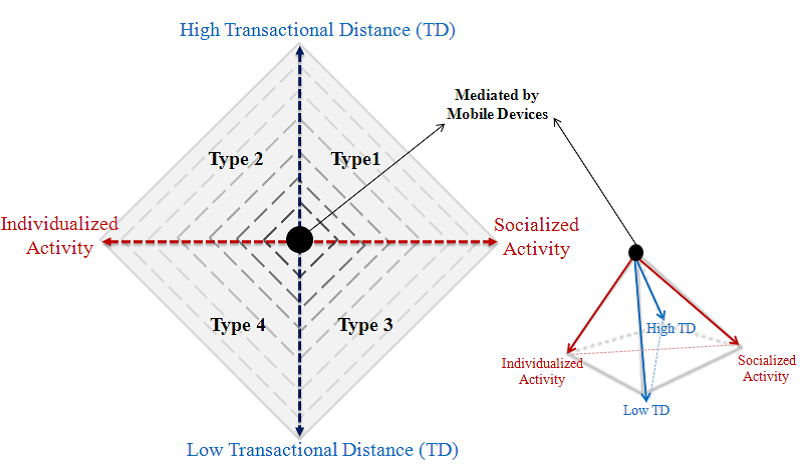
Figure 1.
Four types of mobile learning: A pedagogical framework. Adapted from Park
From my own perspective
Park makes a good argument for choosing TD theory and for the modified version
that is proposed as a framework for the classification scheme. The resulting types are high transactional
distance socialized m-learning, high transactional
distance individualized m-learning, low transactional distance socialized
m-learning, and low transactional distance individualized m-learning. The examples offered by Park provide me with
an indication as to the types of activity that could take place in each
area. Park also highlights what instructional
designers should be aware when setting out to design a new activity and the
need to increase or reduce structure, dialogue and learner autonomy as
appropriate. The adapted framework provides
a simple classification of four types of mobile distance learning for
instructional designers, but more importantly it works towards providing an
evaluation methodology, an aspect that Traxler has indicated is necessary to
sustain the credibility of mobile learning.
Traxler,
J. (2007). Current State of Mobile
Learning. in M.
Alley (Ed.), Mobile Learning
Transforming the delivery of Education and Training (pp 9-24). Edmonton: AU Press Athabasca University
This
chapter begins with Traxler suggesting that whilst theory is a contested topic
in the mobile learning community there is a need for a conceptual base. He argues that such a base would provide a
starting point for evaluation methodologies grounded in the unique attributes
of mobile learning. In order to provide
a theoretical conceptualisation of mobile learning Traxler suggests that there
is a need to define it, but reminds us that because it is essentially “personal,
contextual and situated” it is problematic for definition and evaluation. The chapter goes on to provide definitions of
mobile learning and looks at the case for mobile education. When looking at evaluation Traxler provides
us with the attributes of good evaluation rather than a specific method and
closes with a look at mobile education in universities and colleges.
The
chapter provides us with the current state of mobile learning in that it
illustrates to us the categories of mobile learning that have emerged as a
result of various case studies and pilots that have taken place. The definition of mobile education is not
restricted to what can be provided purely through technology but seeks to
define it looking at the underlying learner experience. Traxler makes the case
for mobile education on “purist” grounds explaining that mobile learning will
support a variety of conceptions of teaching and “impurist” grounds which
recognise that learning takes place in a wider social and economic
context. In evaluating mobile education Traxler
argues that the diversity of mobile education and the complexity of the
technology make existing forms of evaluation inadequate. He suggests that there is a need for
evaluation to have a structured approach and be underpinned by sound
principles. Traxler indicates these
principles and illustrates how they can be used to underpin appropriate
evaluation methodologies.
This
chapter has expanded my knowledge of mobile learning through the identification
of the many categories of mobile learning and through the definition of mobile
education using not just the affordances of the hardware and technology but
drawing on the learner experience as well.
Traxler is very much a proponent of mobile learning and this comes
across in his writing. His descriptions
of e-learning as “conventional” and “tethered” are a little unfair in my opinion. “Conventional” and “tethered” e-learning in
my organisation has released learners from travelling long distances to
seminars as they can complete courses at home, at lunch time or before or after
their work day. Further enhancements to
technology which will be delivered throughout the organisation this year will
see bite sized “just in time” and “just for me” e-learning delivered to
desktops. I acknowledge that mobile
learning would provide further freedoms to our learners especially those who
work out on the road and it would provide an added dimension if introduced into
face to face interventions. I too am a
proponent of mobile learning but I am unable to tag our current e-learning
modules with the adjective “tethered” just yet.
Mobile
Apps
Mobile
Apps (2012). NMC Horizon Report: 2012, Higher Education Edition. Available at http://net.educause.edu/ir/library/pdf/HR2012.pdf
The most recent Horizon
Report puts mobile apps in the near term horizon which suggests the time to
adoption is one year or less. The
article opens up by comparing the effect of the mobile app on the software
industry to the recent changes that have taken place in the music and
publishing industries. It suggests that
apps are changing the way we think about software and comments on the wide
range of apps available. On the topic
of education the report highlights that institutions are rapidly developing
their own apps and making use of existing apps across a wide range of
disciplines. In addition colleges are
recognising that apps are an important feature in the business world and have
responded by providing app development courses that enable students design,
develop and market their own app. The
report concludes by commenting that educational institutions are investing in
infrastructure to support mobile access and sponsoring programs to provide
devices to students who don’t already have them ensuring that the growing
capabilities of mobiles are available to more students in more locations every
year.
2012 is
the year of the app or so it would seem. Prensky has just identified the “app
gap” and now apps appear in the near term horizon as an emerging technology in
their own right. Apps have been mentioned in previous editions of the
report but only in the wider discussions of mobile devices and mobile
learning. While the download statistics provided in the report would suggest
that near term horizon is accurate for deployment, what the report doesn’t tell
us is the number of educational apps that are available and the number that are
downloaded. A statistic that is also missing is the number of apps that
are downloaded and subsequently deleted by users. Indeed even if the app is not deleted there
is no evidence in the report that just because the app is downloaded that it is
used regularly. In a discussion
available at http://www.youtube.com/watch?v=Rr3WOBeBdvM on mobile apps Larry
King of Ironworks admits to having 130 apps but only using 16 on a regular
basis. That apps are here to stay cannot be denied but whether they
should be placed in the near term horizon is another discussion. Only
time will tell if apps follow the trend of other emerging technologies that
have appeared and continue to appear in the Horizon Report as technologies that
will be deployed in the near term.
Prensky,
M. (2011). Eliminating the “App Gap”. Educational Technology Jan-Feb 2012 Retrieved
from http://marcprensky.com/writing/Prensky-EDTECH-EliminatingtheAppGap-Jan-Feb-2012.pdf
In this article Prensky
discusses the issue that although a lot of students attending university have
access to smartphones and apps not all students do. He defines this as the “app gap”. The article continues by Prensky outlining
the “strong and unique” factors that apps bring to the education table and
suggests that the most powerful thing about apps is that if there isn’t one to
suit the needs of the student then it is possible to create one. He concludes by predicting that apps will
become a huge piece of the 21st century learning process and urges
educators to eliminate the “app gap” immediately.
When reading this
article it is easy to get carried away with Prensky’s enthusiasm for apps. He makes a good argument for what apps can
bring to education and cites how his son is successfully using apps to learn
languages, history and geography.
Prensky suggests that apps are better than books or laptops and argues
that they benefit “every student”. But as
every student doesn’t have access to apps, there is a need to eliminate the
“app gap”. In eliminating the gap there will always be a question of cost. On the subject of providing devices, Prensky
tends to generalise suggesting that cost is not really an issue but “many
details have yet to be worked out”. His
argument regarding the cost of apps themselves is more substantive as he makes
the point that many engaging apps are free and those that cost work out at equal
to or less than the cost per chapter of a text book. Prensky also comments that where it’s not
possible to get the appropriate app, institutions can develop their own leading
to a possible source of income and real world skills being acquired by students
who become involved in developing apps.
That Prensky is convinced of what apps can achieve is clear and for him
the issue is the need to take advantage of this technology immediately
I stumbled onto this
article after I had put together my presentation on mobile apps for peer
review. Most of the articles that I had
read during my research provided examples of studies that had taken place and
reported on how apps are used by universities.
Other studies reflected what Prensky suggests and reported on how app
development programmes are providing students with the opportunity to develop
commercially viable apps. Prensky’s
article differs in that he provides the “strong and unique” factors of what
apps can do if used in education. This
is an aspect that I intend to include in my presentation. The challenges of different mobile platforms or the impact on
network infrastructure when high numbers of students are using web applications
are not addressed in this article but it is a short article and Prensky’s aim
is to get educators to sit up and take notice of what this new technology can
deliver and eliminate the “app gap”.
WorkLight
Webinar Series Native Web or Hybrid Mobile App Development [PowerPoint
slides]. Retrieved from http://www.scribd.com/doc/50805466/Native-Web-or-Hybrid-Mobile-App-Development
This presentation is provided by WorkLight an
IBM company as part of a series of webinars.
The presentation analyses the various approaches that can be taken when
developing a mobile app. It looks at
native, web and hybrid apps and discusses the difference between mobile web
apps and mobile browsing. The
presentation concludes by looking at each type of app from a business
perspective and looks at future trends.
The presentation is
written from the standpoint of the developer.
This does much to enhance the presentation as it is written logically
and clearly. There is a high level of
technical information provided regarding the steps and the processes to create
the various apps described. Although my technical
knowledge does not extend to the level of this presentation I’m not excluded
from what the presentation delivers.
Graphics and flow charts provide visually rich information that enable
the viewer understand some of the technical aspects that determine the
difference between these distinctly different apps. There is no preference suggested for either
app. The pros and cons are discussed and
whilst the author suggests that there is no single approach that is right for
everyone ample information is provided that will allow an informed decision to
be made.
In my struggle to come
to grips with the difference between mobile apps and web apps I found this
presentation explained both of these concepts succinctly. Furthermore it introduced me to the concept
of hybrid apps and clarified the issue of mobile web apps versus mobile
websites. As previously mentioned the
information delivered is quite technical.
However the technical feel to the presentation means that the facts are
presented in an objective manner allowing the viewer to make up their own mind about
the advantages for them of one type of app over another. That this presentation can be viewed by
people with varying levels of technical ability is a tribute to its
author. In addition to the information
furnished, the presentation provided me with a concept as to how my own
presentation could be delivered. I have
included this presentation here as it was an invaluable resource for me which I
constantly referred to, it is written for businesses which may be considering
developing a mobile app; however all the information and issues identified are
those which any university would welcome advice on.
Games
Carstens,
J. Beck, J. (2005). Getting Ready for the Gamer Generation Tech Trends, 49(3), 22-25.
Carstens
and Beck have completed research indicating that the new generation of workers
is different from the previous one in significant and verifiable ways.
They suggest that the differences are driven by one central factor and
that is that they have grown up playing video games. This article doesn't
provide the detail of the research but rather outlines the belief system that
games create when played up to adulthood. Carstens and Beck suggest that
in order to harvest the potential of gamers, training needs to reflect this
belief system and trainers should take time out to understand the mind set of
gamers and what motivates them. They conclude that games and gamers are
known for their rapid evolution and to stay on top of this phenomenon it will
be necessary to keep up with what gamers are thinking not only today but also
tomorrow.
In this article the authors suggest that sooner or later those who grew up
without video games will have to understand the gamer as the game generation
starts to take over the workplace. Statistics are provided to illustrate
the extent that Americans are playing video games and Carstens and Beck contend
that while young children and teenagers are playing video games they are doing
so at a time when structural maturation of the brain is taking place. The authors argue that this combination of
factors leads to gamers’ brains being “hardwired” with a particular set of
assumptions and beliefs about how the world works. Carstens and Beck commissioned a study of
2500 Americans with all levels of gaming experience to seek to confirm these new
beliefs. Their research has led to the
publication of a book on the subject. In
this article they outline some of the beliefs found in gamers in the study and
suggest that these beliefs will lead to gamers acting differently in the work
place. One example is that gamers
believe that the world is a competitive place and as a result in the workforce
they are proactive workers who evaluate different ways to solve issues.
This
article like Prensky’s, aims to identify the skills that gamers cultivate while
playing video games. It provides a set
of six guidelines on what trainers should consider when designing training for
gamers and the reasoning behind them. I
would argue that these guidelines would not provide any new information for
trainers who have been designing engaging and interactive training already but
may provide some suggestions for trainers who have used a chalk and talk
approach. That the research has provided some food for thought regarding gamers
and their beliefs cannot be denied, however in this article it is suggested
that gamers of this generation have different attitudes in the workplace
compared to those older than them who didn’t experience game technology growing
up. To compare the gamer of today to the
previous generation seems a little unfair in my opinion when so many other
aspects have shaped the previous generation’s way of thinking other than the
lack of video games. The research does
good work to highlight the skills of gamers but more balance may have been
achieved if the gamer and non-gamer of this generation were compared in the
article
Prensky, M. (2004). The
Seven Games of Highly Effective People. How computer games help you succeed in
school work and life. Retrieved from http://www.marcprensky.com/writing/Prensky-The_Seven_Games-FINAL.pdf
Prensky
refers to Steven Covey’s book “The seven habits of highly effective people” and
asks the question how do people learn these habits? He suggests that one way
people are learning them is by playing computer games. Like Covey,
Prensky looks at the habits in two groups; the first three are “individual
habits” which Prensky suggests are fostered by playing any type of game. The second group of three are described as
“group habits” and Prensky suggests that they are fostered mainly through
multiplayer games. The final habit is
called “sharpen the saw” and refers to working to continually improve skills
and learn new ones; Prensky contends that no group does this as well as gamers
do. The article concludes by citing
research to support the theory that game playing can lead to becoming more successful
in the work place.
Prensky
is a proponent of game based learning and has written many articles and two
books on the subject. In this article Prensky uses Steven Covey's popular
7 habits to further the cause of games. The
article motivates the reader to look beyond the bad press that games often get and
notice the underlying skills or in this case habits that gamers can develop
through playing games. In taking each habit individually Prensky explains how
gamers develop these habits in order to become successful gamers, he suggests
that it’s not possible to be successful as a gamer without them. The article also highlights that the habits
once acquired are continuously worked on to be improved as gamers are
continually practising and seeking out new ways of improving their skills.
Prensky contends that the skills acquired don’t remain tied to gaming but
become part of the gamer’s everyday life.
For me
it’s interesting that Prensky along with Carstens and Beck look at the effect
that games have already had on a generation and how the skills they are gaining
are affecting how they live and work. In
both articles the gamers are playing as a leisure pursuit so the learning is
taking place outside the formal context of a classroom. Neither articles talk about the use of games
in the educational context. While
Prensky looks at the habits gamers cultivate during game play, Carstens and
Beck review the beliefs gamers have about themselves, how the world works, how
people relate to one another and about the goals of life in general. Carstens and Beck state that gamers believe
the world is a competitive place and there is a need to be proactive to
succeed. One of the habits Prensky discusses
the need to be proactive to be successful in game playing. These articles illustrate that playing games
lead to cultivating habits and beliefs that foster 21st century
skills.
Torrente,
J. Del Blanco, A. Marchiori, E.
J. Moreno-Ger, P. and Fernandez-Manjon, B. (2010). <e-adventure>
Introducing Educational Games in the Learning Process. Educational
Engineering Educon (2010), 1121-1126.
doi: 10.1109/EDUCON.2010.5493056
In this journal Torrente, Blanco, Marchiori, Moreno-Ger and Fernandez-Manjon
suggest that there is a need to update content and interactivity in education
in order to improve motivation and engage students. One proposal to
achieve this is the use of video games based on their potential to enhance the
learning process in numerous ways. This interest in the use of games in
education has provided the basis for the e-adventure project which is discussed
in the article. Torrente et al identify issues that have prevented the
adoption of games in education and describe how the issues have been addressed
within e-adventure. The authors continue by describing further research
they are completing and how it will be integrated into e-adventure and finally
conclude that that they will continue to conduct new research and test it within
the e-adventure platform.
In writing this article Torrente et al have identified that there are factors
that affect the adoption of video games in education. They suggest that
these factors are at all stages of the process from design to implementation
and deployment. The information gleaned through their research has
positioned them to identify traits that make some games more suitable for
educational purposes than others and based on their findings they suggest story
driven games can be effective as they improve problem solving skills and
promote reflection instead of action. Their findings have influenced the
development of the e-adventure platform which appears to be a practical
solution that will do much to include the instructor at the design stage without
the requirement of any kind of technical background.
During our discussions on game based learning
it was mentioned that a factor preventing the adoption of games in education is
the lack of software that can enable educators develop games that meet learning
outcomes without the need of technical expertise and of course at a
reasonable cost. As a result of reading this paper I have checked the
e-adventure site. The software developed
by the authors is currently available for download as an open resource and
could provide the starting point I need to introduce learning games. One of the issues with game based learning is
how to assess what has been learnt. The
developers have solved this by providing an option to package the e-adventure
file as a web object that can be uploaded into Moodle. The communication between Moodle and the game
indicates the areas of the game successfully completed and those that may
require further attention. The
additional benefit of deploying the game through Moodle is that there is no
need for the installation of software to allow the game to run on learners’
machines. The e-adventure web site invites
developers to check back in the future if they don’t like e-adventure in its
current format, indicating as the paper has advised that they are continuously
researching to improve the software. I
would like to explore this software before coming to the conclusion of how
effective it is in its current format. In
the meantime as the paper has identified how the software overcomes the issues
that may be encountered from design to deployment, I am cognisant of the characteristics
that I should be aware of if evaluating software for game development.
Whitton,
N. Hollins, P. (2008). Collaborative Virtual gaming Worlds
in Higher Education. ALT-J, Research in Learning Technology, 16(3),
221-229.
This
paper acknowledges that there is a growing interest in the use of virtual
gaming worlds in education but argues that collaborative gaming worlds have
been in use much longer than these games and much wider in scope. Whitton
and Hollins explore the educational benefits of gaming environments in higher
education and review pedagogical approaches. They discuss the practical
aspects that need to be considered when using virtual gaming worlds in the
formal setting of higher education and provide development options. In particular they suggest the potential of
Alternate Reality Games (ARG). The paper concludes with a look to the
future outlining two areas where gaming in higher education may be used,
providing a warning that the novelty effect of using these environments should
be considered both from the student and teacher perspective as this may
influence long term acceptability and effectiveness.
The authors acknowledge that the focus of the paper is unashamedly on the use
of gaming environments with adults in higher education as this is an area that
they feel is often neglected in terms of research. In addition Whitton
and Hollins recognise that gaming environments may be used effectively for a
variety of pedagogical approaches but concentrate solely on the constructivist
perspective. The paper flows from beginning to end as each topic finishes
with a summary that leads to the next subject for discussion and while the
authors are proponents of the use of gaming environments within the context of
higher education they illustrate the issues and challenges that can be
experienced and provide possible solutions. This paper is well written
and provides the reader with practical suggestions and advice on the topics of
pedagogical design, the practical use of virtual gaming worlds and the
selection of virtual gaming environments.
The
discussion with regard to virtual gaming worlds in this paper has allowed me to
consider their use within a workplace context.
The area where they could prove to be effective is in the provision of a
safe environment that would allow new learners gain the skills required to
conduct on site surveys. Indeed the
context would be equally effective with existing learners allowing them to
update and improve their current skills.
However the authors point to the development time and expense that is
involved in creating effective educational environments and although they
suggest a possible alternative in the use of Alternate reality Games (ARG) the
time and development costs of ARG would suggest that there is a significant
investment required that would prohibit their introduction at present. Although
costs and time are factors that cannot be overlooked, Traxler also mentions the
culture of the organisation as a barrier to the introduction of
technology. There are a significant
number of non-gamers within the organisation.
Reflecting on this my thoughts are that regardless of the time spent on
the development of the gaming environment there is a need to spend time
preparing the learners to ensure a positive experience within the gaming
environment. At the moment the solution
may be to start introducing game based learning on a smaller scale and work
towards virtual learning worlds as a possibility of the future.
March/ April 2012
